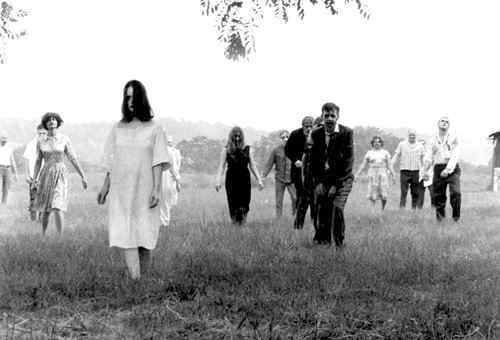
In the cult classic horror film, The Night of the Living Dead released in 1968, the dead return as flesh eating ghouls causing panic among the living. After analyzing this film through Stuart Hall’s essay “The Work of Representation,” constructed meanings rely on social and historical contexts, yet I find that these meanings are not so different now from its premiere almost 45 years ago. Critics claim the representation of homicidal ghouls symbolizes the cutthroat nature of capitalism, which still remains a heated debate among democrats and republicans in our present economy. Feminists argue that the lead female character, Barbra, portrays a weak heroine dependent upon men. However, in her defense as helpless, I understood her character as one in a state of shock that gave her humanistic qualities. In a way she became a zombie because of her depressed emotional state over the loss of her brother. This shows the connection of the living and the dead and their similar catatonic presence. She didn’t simply move on and leave him behind like he never existed as others might have, but she mourns him becoming a type of zombie herself. She also loses her life going to fight off the zombies to save another woman showing her bravery. The other female costar, Judy, leaves the safe house to accompany her boyfriend in the ghoul-infested yard in hopes to make an escape. In my opinion these women showed as much strength as the men at certain times, especially in comparison to the weak husband, Harry Cooper, who selfishly put his life as top priority leaving the others out to dry. Critics also praise the director George Romero for casting an African American man as the lead in a cast of white European-Americans, but black people still rarely lead a cast of predominantly white actors. I believe the dominant discourse is still very similar to that of 1968, and the very things viewers questioned then we still question now.
 |
| You fear what's in your own heart |
Another intriguing element in the film is the role of the media. The first thing each person notices in the house is the radio and what the broadcasters are saying about the epidemic. The radio acts as a lifeline to the outside world relaying the message that there is still a sane humanity. From now back to the sixties media holds the power, as Hall writes, “that in certain historical moments, some people had more power to speak about some subjects than others” (42). Here we can see the everlasting powerful voice of the media. Even the concerned mother leaves her dying child’s side to watch the television broadcast of what’s going on in the world outside of the attacked house. Right after the broadcast is over they all agree to follow the journalists advice and leave their confine in search of the government safe houses. No questions asked their knowledge of what’s happening outside does not hold as much value as the national news, but in reality they know just as much as anybody out there. The lead hero, Ben, knows that the ghouls fear fire because of personal experience, not from information he received from the news. In this sense Ben should be seen as more powerful and knowledgeable, but the voice of the media reigns true. Here we see another one of Hall’s points: “knowledge linked to power, not only assumes the authority of ‘the truth’ but has the power to make itself true” (49). To this day media holds the image as a voice of truth, but clearly this position can be questioned considering everyone dies after following their advice. As viewers the truths we take from this film vary on personal experience, but we construct these truths through specific social and historical contexts, which haven’t changed too dramatically over the years. Romero presents timeless themes that shake viewers and question our sense of morality in times of mass hysteria.